


Landscaping Guide
Backyard Landscaping Ideas With Fire Pit: Layouts, Lighting & Seating (2026)
The fire pit anchors the hardscape. The plants, paths, and lighting build the landscape around it. Here is the system, from the ground underfoot to the light overhead.

The quick answer
Landscaping Around a Fire Pit
Hardscape first, plants second. The fire pit needs a non-combustible base — gravel, pavers, or concrete. Define the seating zone with hardscape. Layer plants around the perimeter at 4-plus feet. The hardscape is the floor. The plants are the walls.
Drainage determines whether the fire zone is usable after rain. Grade the surface away from the fire pit at 1 to 2 percent slope — roughly a quarter-inch drop per foot. A fire zone that floods after every rain becomes a fire zone that nobody uses.
Light the landscape, not just the fire. Uplights on trees behind the seating zone. Path lights along the walkway at 6-to-8-foot spacing. The fire provides the center light. Landscape lighting provides depth and defines the perimeter of the room after dark.
Fire Pit Hardscaping: Pavers, Gravel, and Retaining Walls
The ground beneath and around the fire pit determines how the space functions — where water drains, how heat radiates, and whether chairs sit level or wobble. Three hardscape approaches cover most backyard settings. The differences in cost, installation difficulty, and long-term performance are worth understanding before you excavate.
Gravel: Best All-Around Value for Fire Pit Seating Areas
A 12-foot diameter circle of three-quarter-inch crushed granite or pea gravel. It drains instantly and reflects heat upward into the seating zone rather than absorbing it like solid pavers. The crunch underfoot defines the fire zone acoustically — guests know when they have entered the gathering area. Edge the gravel with steel or stone to keep it contained. Compact the base with 4 inches of crushed stone before adding 2 inches of surface gravel. The base layer handles drainage. The surface layer provides the texture and the sound.
The best gravel for a fire pit seating area is three-quarter-inch angular crushed granite. Angular stone locks together underfoot — it stays in place better than rounded pea gravel, which shifts and tracks onto adjacent surfaces. Avoid decomposed granite for the surface layer — it turns to mud in heavy rain and dust in drought. It works as a base layer. It fails as a walking surface around a fire pit.
Pavers: Cleanest Look, Highest Cost
Large-format concrete pavers or natural flagstone. Set on a compacted sand-and-gravel base. The fire pit sits on the pavers — on a fire-rated pad that protects the pavers from radiant heat, not directly on the paver surface. Pavers read as permanent and polished. They stay cooler underfoot in summer than dark gravel, which absorbs and radiates solar heat. The trade-off: pavers cost 3 to 5 times more than gravel and require professional installation for a level surface that drains correctly. A paver patio around a fire pit runs roughly $12 to $25 per square foot installed, depending on the paver material and regional labor rates.
| Surface | Cost per sq ft | Drainage | Heat Reflection | Installation | Best For |
|---|---|---|---|---|---|
| Crushed Granite | $2–$5 | Excellent — drains instantly | High — reflects upward | DIY weekend project | Budget, natural look, renters |
| Concrete Pavers | $12–$25 | Good — if base is graded correctly | Moderate — stays cooler in summer | Professional recommended | Clean, permanent, polished look |
| Concrete Pad | $8–$15 | Needs built-in slope or drains | Moderate-to-low | Professional required | Sloped yards needing a level terrace |
Fire-Safe Planting Around a Fire Pit: What Survives the Heat
The zone within 6 feet of an active fire pit functions as a heat microclimate. Plants in this radius experience temperatures 10 to 20 degrees Fahrenheit above ambient on a still evening, plus radiant heat that dries foliage faster than the surrounding landscape. Choose plants that tolerate dry heat. Avoid plants that ignite easily or drop debris into the fire zone.
Fire-Safe Planting Zones: The 3-Ring System
Inner ring (0 to 6 feet). Non-combustible hardscape only — gravel, pavers, or concrete. No plants in this zone. The radiant heat and occasional ember from a wood fire make any plant material in this ring a fire risk. For propane fire pit tables, the risk is lower but the heat still desiccates foliage within 3 to 4 feet. Keep this ring plant-free.
Middle ring (6 to 10 feet). Succulents and ornamental grasses. Agave, sedum, hens-and-chicks — their water-filled leaves resist ignition. Fountain grass, blue fescue, switchgrass — prairie grasses that evolved with annual fire cycles. Their low moisture content and deep roots make them nearly fireproof. Lavender and rosemary — aromatic, drought-tolerant, and the oils they release when warmed by the fire add to the sensory experience. Large planted containers — half wine barrels, Corten steel planters, stone urns — function as physical firebreaks at the 6-foot radius mark.
Outer ring (10-plus feet). Standard landscape plants. Deciduous trees with canopies pruned to 10 feet above the fire zone. Broadleaf shrubs that hold moisture. What to avoid in this ring: conifers — juniper, arborvitae, pine — their resin content and fine foliage are highly flammable. Broadleaf evergreens with waxy leaves — rhododendron, holly — the wax coating ignites at lower temperatures than standard foliage.

Drainage: The Detail That Determines Whether the Fire Zone Is Usable After RainGrade the hardscape surface away from the fire pit at 1 to 2 percent slope — roughly a quarter-inch drop per foot. Water runs off rather than pooling around the seating. For gravel: the base layer handles drainage naturally — 4 to 6 inches of compacted crushed stone below 2 inches of surface gravel. For pavers: the slope is built into the sand bed during installation. A fire zone that floods after every rain becomes a fire zone that nobody uses. The drainage detail is invisible when it works and obvious when it fails.
Fire Pit Lighting: Layers That Extend the Evening
The fire pit is the brightest thing in the yard after dark. Everything else should be dimmer — supporting the flame rather than competing with it. Three layers of light, each dimmer than the fire, create a space that reads as intentional rather than dark.
Lighting Color Temperature: Why 2700K Matters
Warm white — 2700K to 3000K — matches the color temperature of a gas or wood flame. Cool white — 4000K and above — reads as fluorescent and kills the firelight ambiance. This is the single specification that determines whether outdoor lighting feels like a restaurant patio or a backyard. Buy 2700K bulbs, low-voltage LED for the path lights and uplights, warm white for the string lights. If the bulb packaging does not list a Kelvin rating, it is likely 4000K or above. Skip it.
Overhead: string lights. Suspended 8 to 10 feet above the fire zone on a cable system or between anchored posts. Warm white only. Position them in a perimeter — a square or rectangle that encloses the seating zone without crossing directly over the flame. A bulb directly above the fire reads as an accident waiting to happen, even if it is safely out of reach.
Mid-level: path lights. Low-voltage LED stake lights at 12 to 18 inches high. Mark the route from house to fire zone. Space them 6 to 8 feet apart. The light should illuminate the ground, not shine into guests' eyes. Solar path lights work in regions with consistent sun but dim noticeably after 3 to 4 hours — wired low-voltage is more reliable for evening-long illumination.
Ground level: the fire itself. The flame is the primary light source. It illuminates faces from below — the most flattering angle for conversation. If the string lights or path lights read as brighter than the fire, the fire becomes decoration rather than the focal point. Dial everything else back until the fire is the center of the visual field, with the other lights filling the peripheral areas the flame cannot reach.

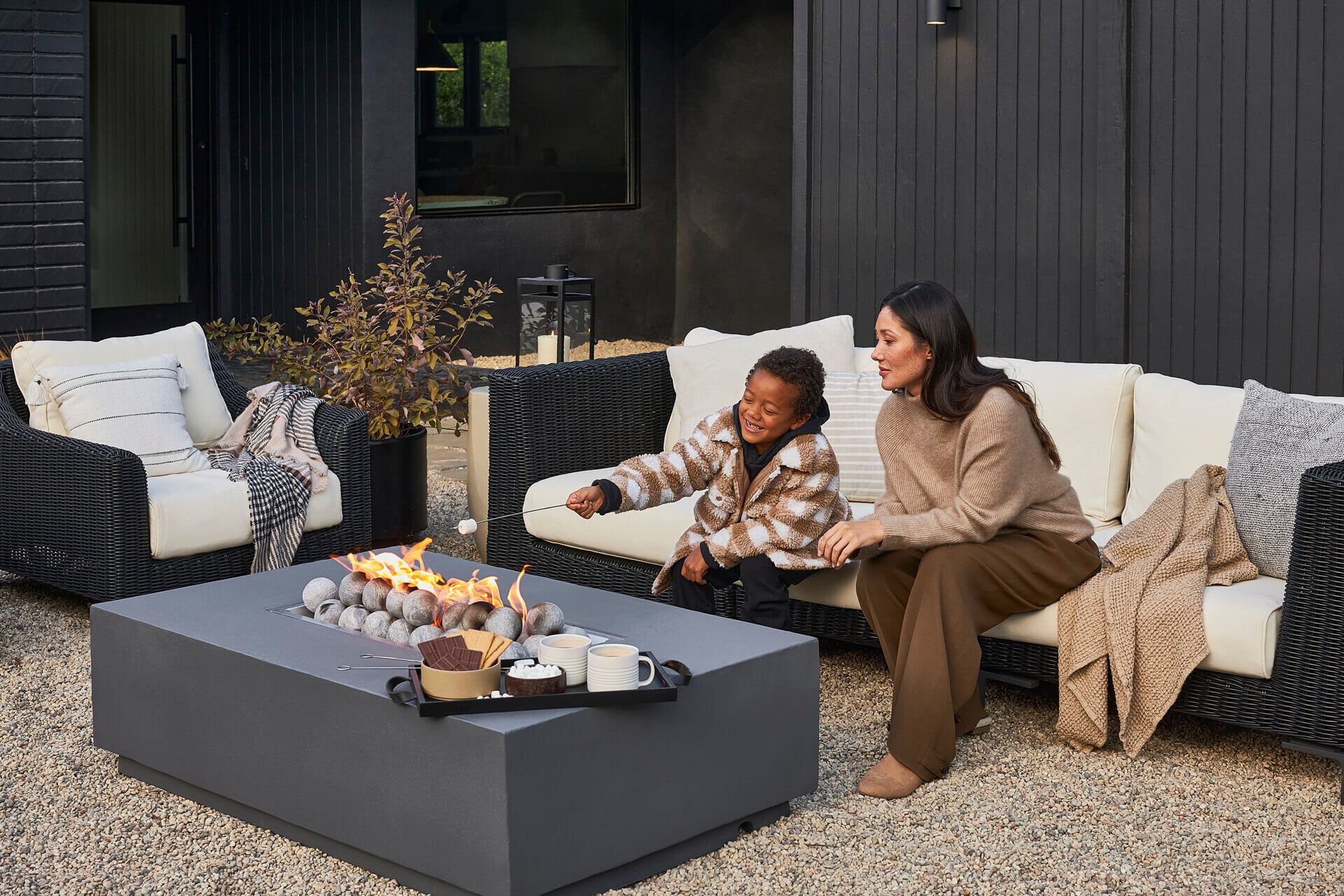
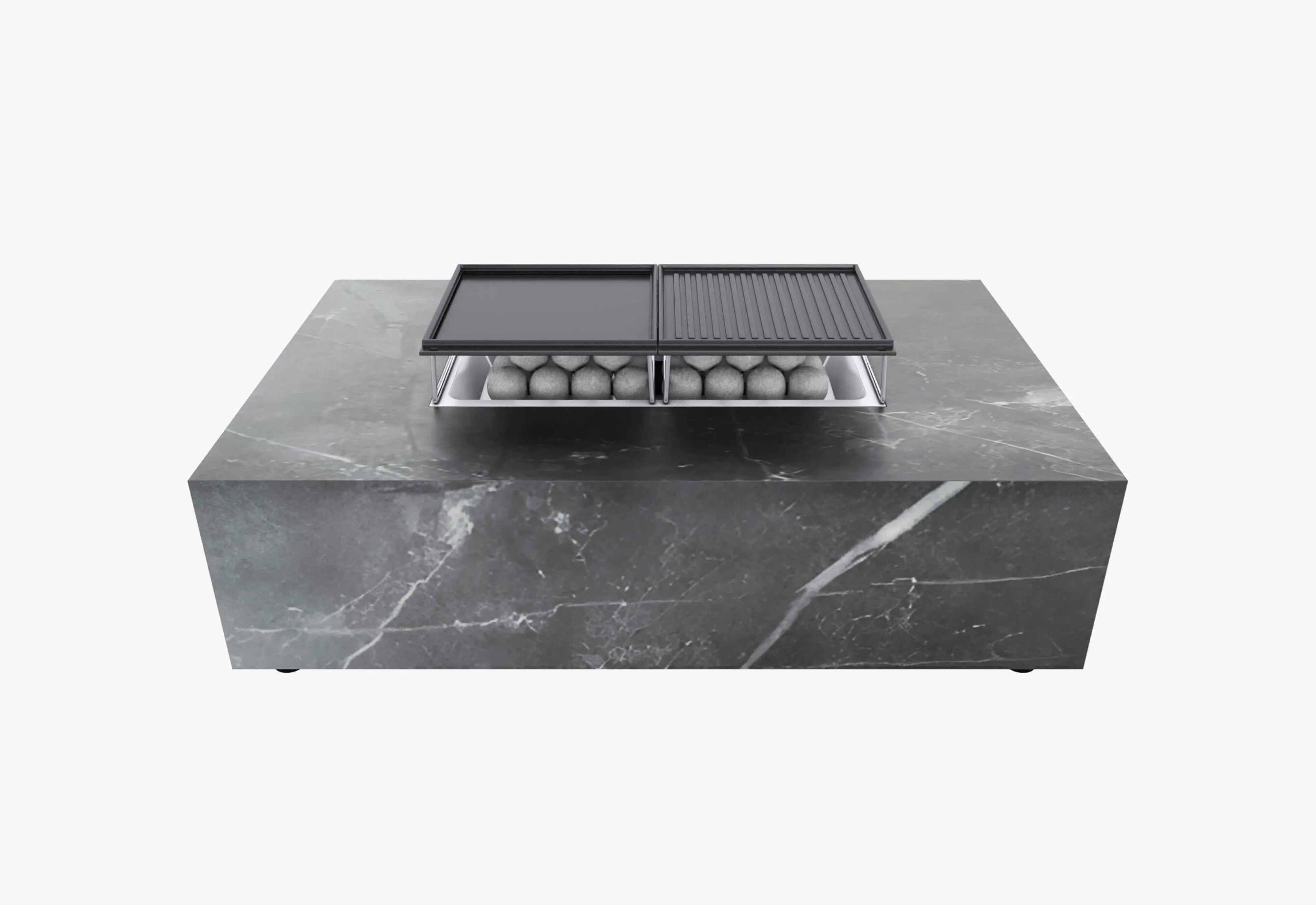
Outer Fire Pit Table
Sits on any non-combustible hardscape. OuterStone composite top. Grill, fire, table — one footprint.

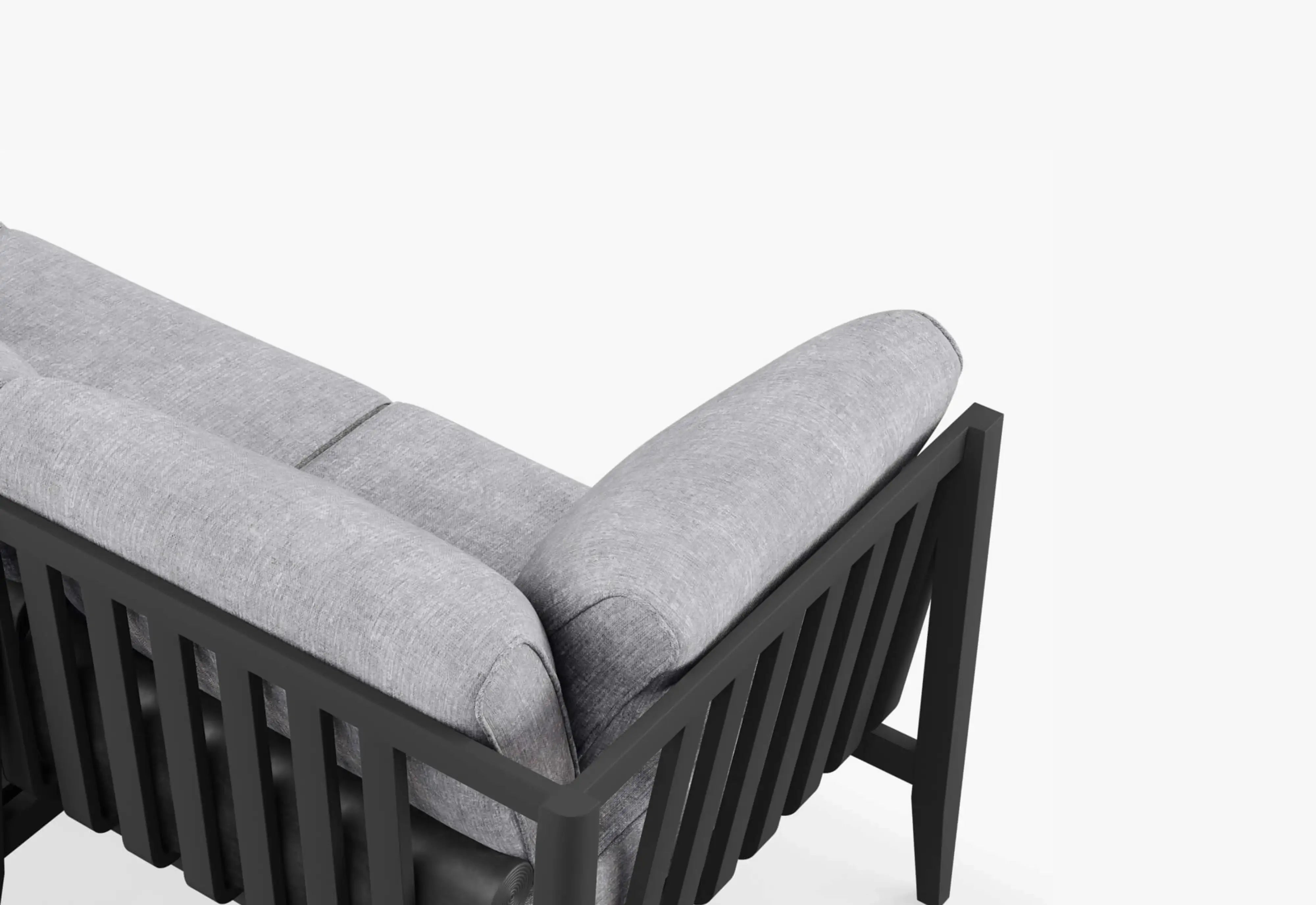
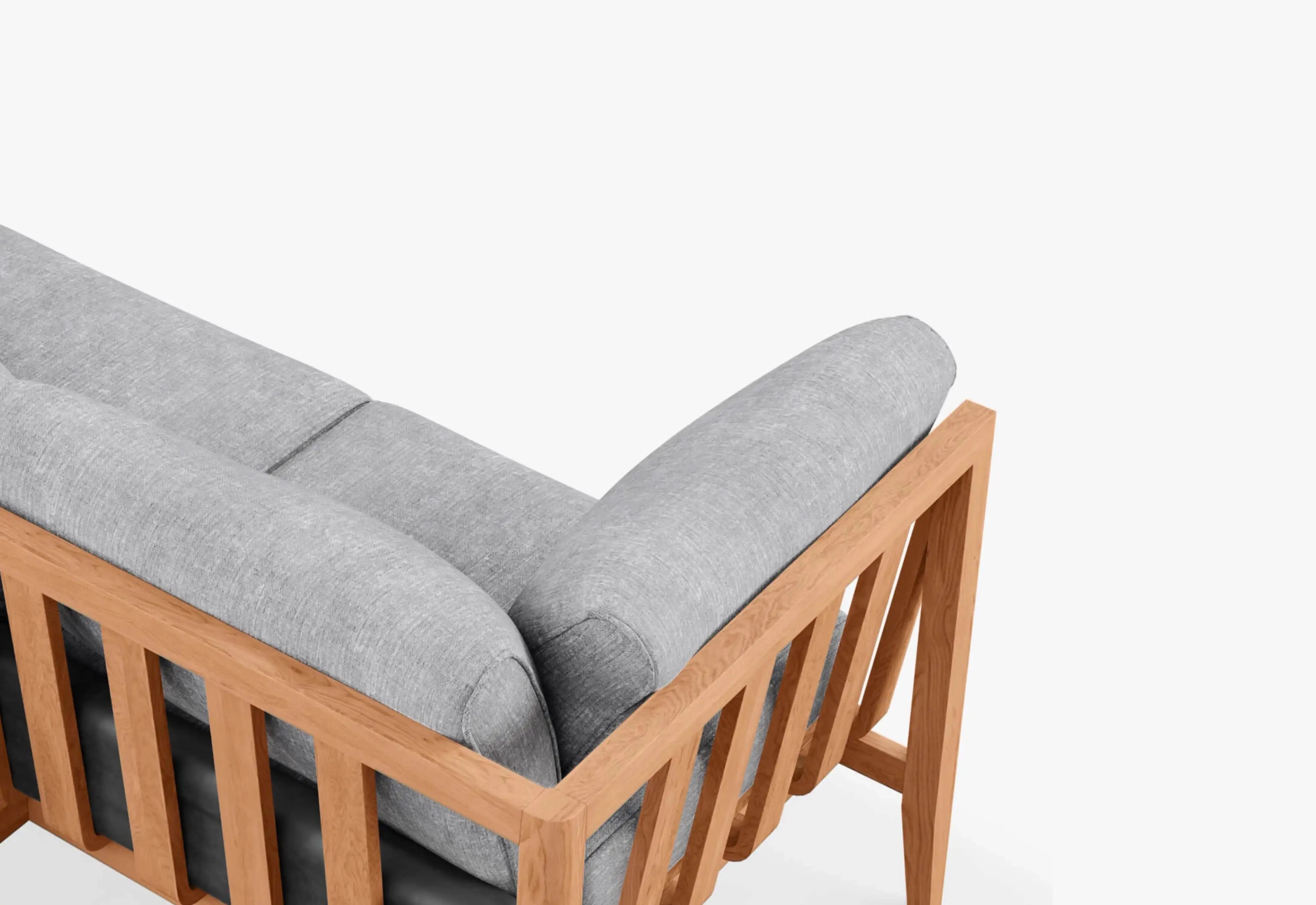
Wicker U Sectional — 6 Seat
Modular, weatherproof, OuterShell® built in. Arrange around the fire pit to complete the landscaped room.
Complete the Setup
Fire Pit Tables and Seating for Landscaped Outdoor Rooms
Outer Fire Pit Table — Rectangular
OuterStone composite top handles weather year-round. Sits on any non-combustible hardscape. Grill, fire, and table in one footprint.
OuterStone top
Aluminum base
Wicker U Sectional — 6 Seat
Modular HDPE wicker on aluminum. Arrange to face the fire. OuterShell built in. Brown wicker blends with natural hardscape.
OuterShell built-in
Brown wicker
Common questions
Fire Pit Landscaping Questions, Answered
What is the best gravel for a fire pit seating area?
Three-quarter-inch angular crushed granite. It locks together underfoot — it stays in place better than rounded pea gravel, which shifts and tracks onto adjacent surfaces. Angular stone creates a stable walking surface that drains instantly and reflects heat upward into the seating zone. Avoid decomposed granite for the surface layer — it turns to mud in heavy rain and dust in drought. The ideal setup: 4 to 6 inches of compacted crushed stone as the base layer, topped with 2 inches of three-quarter-inch angular crushed granite. Edge with steel or stone to contain the gravel within the fire zone.
How far should seating be from a fire pit?
For a wood-burning fire pit: 6 to 7 feet minimum from the fire pit edge to the front of the seating. Wood fires produce embers that can travel 4 to 5 feet in light wind. For a propane or natural gas fire pit table: 2 to 3 feet. The controlled flame produces no embers, and the lower heat output creates a tighter, more intimate seating radius. A fire pit table with a 2-to-3-foot clearance seats 6 to 8 people in roughly the same footprint a wood-burning fire pit needs for 4 people seated at safe distance.
Can I install a fire pit on a slope?
Yes — with a retaining wall. A retaining wall turns a hillside into a flat fire pit terrace. The wall itself can double as built-in seating at 18 inches high with a backrest of stacked stone or timber. The fire pit sits on the newly leveled terrace. Walls over 3 feet require engineering and a permit in most jurisdictions. For slopes under a 5-percent grade, a gravel pad graded to level may be sufficient without a retaining wall. For anything steeper, budget for the retaining wall — it is the most expensive single element in a sloped-yard fire pit landscape, but it is also the element that makes the fire zone possible.
What plants should I avoid near a fire pit?
Conifers — juniper, arborvitae, pine — their resin content and fine foliage are highly flammable. Broadleaf evergreens with waxy leaves — rhododendron, holly — the wax ignites at lower temperatures than standard foliage. Anything with peeling bark — birch, sycamore — the loose bark catches floating embers. Deciduous trees with low canopies — prune branches to 10 feet above the fire zone before the first fire of each season. Within 6 feet of the fire pit, keep the zone plant-free with non-combustible hardscape only.
How far should a fire pit be from the house?
Minimum 10 feet from any structure — house, garage, shed, fence, pergola. This is both a safety requirement and a practical one: smoke and heat need distance to dissipate before reaching windows and siding. For propane fire pit tables, 4 feet minimum from structures per manufacturer specifications. Check local fire codes — some jurisdictions require 15 to 25 feet for wood-burning fire pits. The 10-foot minimum is the baseline. More distance reduces smoke intrusion and heat reflection off exterior walls.
The hardscape. The plants. The fire. One complete room.
Every Outer piece includes OuterShell built-in cushion protection.